Maze Therapeutics

advancing R&D in common disease

Utilizing Maze Compass™, we are harnessing the power of human genetics to develop novel, small molecule precision medicines for patients living with renal, cardiovascular and related metabolic diseases, including obesity.

MZE829 for APOL1-Mediated

Kidney Disease (AMKD)

In the United States, approximately six million, or 13%, of African Americans have mutations of both copies of the high-risk APOL1 gene variants, and are at risk for developing AMKD. It is currently estimated that approximately 20%, or over one million, of those individuals have AMKD.

Click here to learn more

MZE782 for Chronic Kidney Disease and PKU

Chronic kidney disease (CKD) impacts approximately 37 million, or 1 in 7 individuals in the U.S. alone.2 Current treatments for CKD do not address the underlying cause and instead focus on slowing the progression. Phenylketonuria (PKU) is an inherited metabolic disorder impacting approximately 60,000 patients worldwide. While PKU treatment options exist, their effectiveness is limited for some patients, and adhering to a low-Phe diet over a lifetime can be challenging for many individuals.

Click here to learn more

2. Source: https://www.cdc.gov/kidneydisease/publications-resources/ckd-national-facts.html
image

MZE829 – a genetically-informed approach to APOL1-mediated kidney disease (AMKD)

AMKD is a life threatening, genetically driven form of CKD. People who have high-risk coding variants in both copies of the APOL1 gene have a heightened risk of developing CKD. Patients who develop AMKD have one or both of the two high-risk variants of the APOL1 gene, G1 and G2, in both copies of their APOL1 gene, which can lead to kidney injury and interference with the kidney’s ability to filter harmful substances from the blood.

The high-risk APOL1 gene variants are most prevalent in people of West African ancestry, including many who identify as Black, African American, Afro-Caribbean and Latina/Latino. These high-risk APOL1 gene variants likely evolved to protect individuals from Human African trypanosomiasis, or HAT, which causes sleeping sickness. HAT is endemic in sub-Saharan Africa and caused by protozoan parasites transmitted by infected tsetse fly bites.

In the United States, approximately six million, or 13%, of African Americans have mutations of both copies of the high-risk APOL1 gene variants, and are at risk for developing AMKD. It is currently estimated that approximately 20%, or over one million, of those individuals have AMKD.

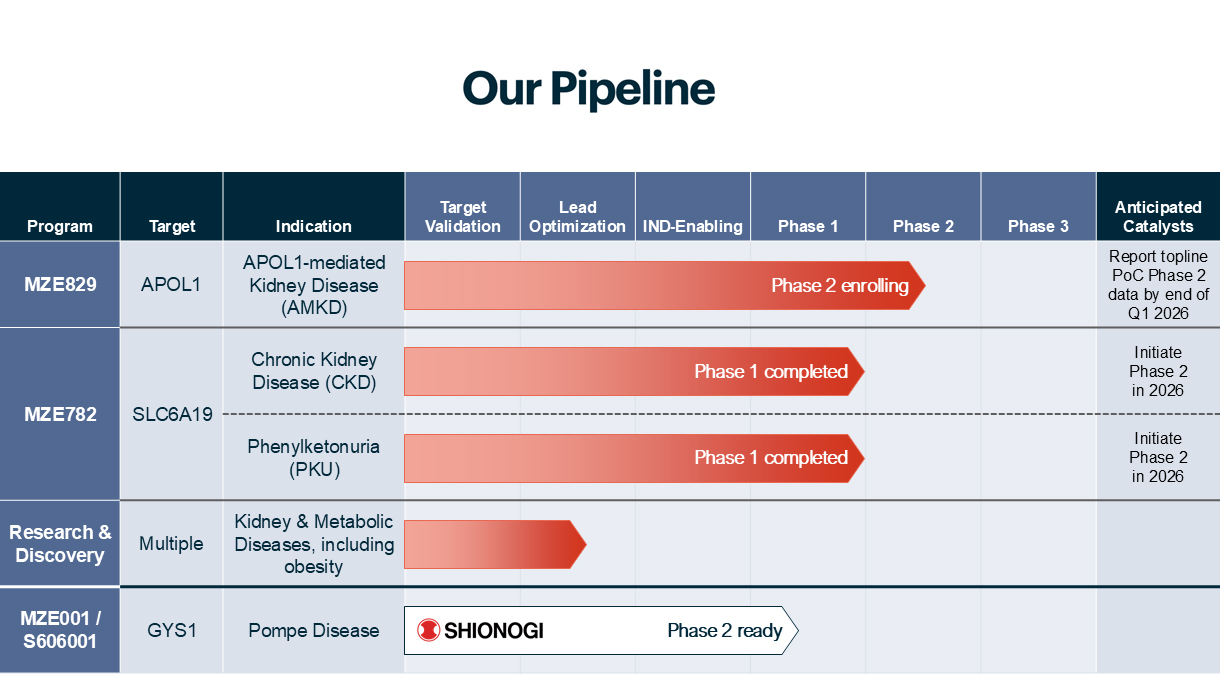
MZE829 is an oral, small molecule inhibitor of APOL1, for the treatment of patients with AMKD. Although the link between APOL1 variants and renal dysfunction has been known for over a decade, we have identified a new protective variant that underpins our therapeutic approach for MZE829 is currently being evaluated in the Phase 2 HORIZON Study and we expect to report proof of concept data in the first quarter of 2026.

MZE782 – a precision approach for chronic kidney disease (CKD) and phenylketonuria (PKU)

CKD is a serious, progressive condition characterized by the gradual loss of kidney function over time, posing significant health risks and economic burdens. CKD affects approximately 37 million patients in the United States, where it is expected to be the fifth most prevalent chronic disease by 2040, and an estimated 700 million patients worldwide. CKD manifests through various stages, culminating in end-stage kidney disease, necessitating dialysis or kidney transplantation for survival. Current treatments for CKD consider patients as falling into clinical categories and focus on slowing disease progression, but do not target the underlying genetic drivers of disease.

PKU is a rare, inherited metabolic disorder caused by pathogenic variants in the phenylalanine hydroxylase (PAH) gene, leading to impaired phenylalanine metabolism and toxic accumulation of phenylalanine in the blood and brain. Elevated phenylalanine levels are associated with significant, lifelong neurological and neuropsychiatric complications, including cognitive impairment, executive dysfunction, and reduced quality of life. PKU affects approximately 60,000 individuals worldwide, and requires continuous, lifelong management. Current treatment options for PKU include strict dietary protein restriction, medical foods, and therapies designed to lower circulating phenylalanine levels.

We are advancing MZE782 for the treatment of both CKD and PKU. MZE782 is an investigational, potent, selective, oral inhibitor of SLC6A19, a sodium-dependent neutral amino acid transporter expressed in the small intestine and kidney proximal tubule that plays a key role in the absorption and reabsorption of neutral amino acids, including Phe.

In CKD, SLC6A19-mediated reabsorption has the potential to contribute to metabolic overload in the proximal tubule of the kidney. We have identified protective genetic variants of the SLC6A19 gene that show that blocking this transporter may therefore reduce the burden of amino acids and toxins, potentially slowing disease progression. The potential mechanism is complementary to, as well as distinct from, SGLT2 inhibition.

In PKU, SLC6A19 enables Phe uptake from the gut and reabsorption in the kidney – two key contributors to elevated plasma Phe levels in patients with deficient PAH activity. Inhibiting SLC6A19 with MZE782 offers a genotype- and PAH-agnostic, oral approach to lowering plasma Phe by limiting its entry into circulation.

We plan to initiate Phase 2 studies for PKU and CKD in the second half of 2026.

MZE001 – an oral substrate reduction therapy for Pompe disease

People with Pompe disease have insufficient acid alpha-glucosidase (GAA) – the enzyme that breaks down extra glycogen in the body - because of mutations in the gene that encodes GAA. As a result, glycogen builds up in muscle tissues causing progressive problems with ambulation (walking and other movement), respiration (breathing) and heart function. The current standard of care, enzyme replacement therapy, attempts to add back GAA, but this doesn’t always get to the muscle tissues, and in some patients, loses effectiveness over time. In addition, current enzyme replacement therapies are delivered by intravenous infusion every 2 weeks, a time consuming and life-long treatment that places significant constraints on patient quality of life. Substrate reduction therapy slows down the production of glycogen to restore more normal levels of glycogen in muscle, and has the potential to remove the toxic effects of too much glycogen. While the idea for substrate reduction therapy is not new, and has been used to treat other diseases, Maze scientists have been able to solve 2 problems that have daunted the development of an oral medicine to treat Pompe disease by inhibiting Glycogen Synthase 1 (GYS1), the enzyme responsible for making glycogen in muscle. We used our CompassTM platform to analyze genetic and clinical data from large numbers of anonymous people to demonstrate that it would be safe to reduce glycogen production, and determined the molecular structure of GYS1 to allow the discovery of a potential therapy, MZE001, that would specifically slow down glycogen production in muscle but not other tissues that need glycogen for energy. We have already studied MZE001 in healthy people, and found that at safe doses, MZE001 slows down the production of glycogen specifically in muscle to a level that could restore normal muscle glycogen levels in patients with Pompe disease. The next step in bringing MZE001 closer to patients will be a Phase 2 study in patients with late-onset Pompe disease.

Privacy Overview

This website uses cookies so that we can provide you with the best user experience possible. Cookie information is stored in your browser and performs functions such as recognising you when you return to our website and helping our team to understand which sections of the website you find most interesting and useful.

Strictly Necessary Cookies

Strictly Necessary Cookie should be enabled at all times so that we can save your preferences for cookie settings.

3rd Party Cookies

This website uses Google Analytics to collect anonymous information such as the number of visitors to the site, and the most popular pages.

Keeping this cookie enabled helps us to improve our website.